TL;DR

Running an ethical business can be challenging in industries filled with misleading marketing and unrealistic promises. Honest providers focus on transparency, realistic expectations, and clear communication. While doing things the right way may mean losing some short-term opportunities, ethical businesses build stronger relationships, earn lasting trust, and create long-term success.

The Reality Ethical Business Owners Face

It’s hard to be an ethical business owner.

If you have ever searched for services for your business, you have seen them. Ads saying your current provider is ripping you off, that you are not doing things the right way, or that if you sign up with them, everything changes in 2 weeks.

A frustrated small business owner looks at exaggerated marketing promises on a laptop while researching unethical business practices affecting small businesses in the United States.

The Rise of Misinformation and Disposable Businesses

Unfortunately, in today’s world, it is easy to spread misinformation or be deceitful without repercussions. They take as much money as they can, and once they get a bad reputation, they just pay $50, start a new LLC with a new name, or simply post under a different name because they never created a legal business to begin with, and just start anew. This phenomenon crosses all industries and is way too prevalent.

The Impact on Honest Business Owners

As a business owner myself, it is hard to see things like this. Not only does this impact ethical businesses and their ability to make a living, but it also taints the industries they are in.

Dishonesty, disingenuousness, and straight-up scams are what we fight against every day. You want to provide the best service you can, at a fair price, but how do you compete against that?

Rebuilding Trust With Potential Clients

And more importantly, how do you convince a potential client who has already been burned that you are different?

What Should an Ethical Provider Cover?

What Should Be Discussed in the First Conversation?

An ethical provider should be covering these points with you in your very first conversation. If they are not bringing these things up on their own, that tells you something.

Should a Provider Guarantee Results?

An ethical provider will be upfront about what they can and cannot deliver. Any business promising a guaranteed outcome in a field with real variables is either being dishonest with you or does not understand its own industry. Both are a problem. If they tell you they can 100% deliver some specific outcome, walk away.

Should Pricing Be Transparent Before the Sales Process Begins?

An ethical provider should have their pricing available to you before the sales process even begins. If they are hiding it until they have had 45 minutes to warm you up, ask yourself why.

Should a Provider Use High-Pressure Sales Tactics?

An ethical provider wants you to make an informed decision, not a rushed one. If someone is pushing you to sign before you have had time to think, that is not urgency; that is a red flag.

Should a Provider Clearly Explain What They Do?

An ethical provider should be able to walk you through their process in plain language. If you ask and get a vague answer full of buzzwords, that is worth paying attention to. You deserve to know what you are paying for before you pay for it.

Should Providers Be Transparent About Results?

An ethical provider should be showing you actionable information freely and walking you through it regularly. They should be showing you all of the results, not just the positive ones. Negative trends happen in every industry. It is how they pivot their strategy to account for those trends that matters.

Should a Provider Stay Current With Industry Trends?

An ethical provider should be proactively informing you of changes in the industry and explaining how they are adjusting their processes to account for them. If they are not doing that, there is a good chance you are receiving outdated services that may no longer apply to the current landscape.

This is especially important in industries like ours, where things can change on what feels like a daily basis. A good provider is not just doing the work; they are constantly evolving how they do it.

What Should You Do If These Topics Are Not Covered?

If your provider is not covering these things with you on their own, ask about them. The way they respond will tell you a lot.

If you are a fellow business owner, you already know this dynamic all too well.

Two professionals review charts on a laptop while discussing marketing strategy to support service based business growth in the United States.

What Ethical Businesses Are Up Against

Losing Deals to Overpromises

When you commit to doing things the right way, you lose deals. That is simply the truth. Some clients will choose the competitor who promises the moon, and there is not much you can do about it except know that call tends to come back around eventually, usually after they have wasted time and money finding out the hard way.

Having Harder Conversations Up Front

You also end up having harder conversations up front. Being honest means telling someone their expectations are not realistic, or that their timeline does not match what the work actually requires. Those conversations are not easy, and they do not always go the way you hope. Life has enough uncertainties. A good service provider should be reducing those, not adding to them.

Rebuilding Trust After Bad Experiences

And then there is the skepticism you inherit from bad actors you have never even met. By the time some clients find you, they have already been through a bad experience somewhere else. Rebuilding that trust takes time, and it is time you are essentially spending to clean up someone else’s mess. That is a real cost that does not show up anywhere on a balance sheet.

Not Every Client Relationship Is the Right Fit

Sometimes a client and a provider just do not mesh, and that is okay. Not every relationship is the right fit, and forcing one that is rarely ends well for either side. Go with your gut while making an informed decision. A provider that is right for you will feel that way from the start.

The Long-Term Payoff of Ethical Work

Despite all of that, the businesses that stay the course tend to be the ones still standing years later. The clients are better, the relationships are deeper, and the work is more meaningful. That is not a coincidence.

What Does the Long-Term Impact of Ethical Business Look Like?

Continuing the Values the Business Was Built On

When my wife Mary and I became business owners, we were fortunate to purchase a business that already maintained these values. Word of mouth advertising works, and in our case, it was the foundation of the business. When you run things that way, people notice. They are able to refer their colleagues to you without fear, because they know what you stand for.

Combating Unscrupulous Businesses

The only way to combat the agencies and businesses that are, for better terms, unscrupulous, is to be exactly the opposite. Be open. Be honest, even when it costs you. Build real relationships. And above all, be human to each other. That is how you stay true to yourself and help other people along the way.

A Message to Fellow Business Owners

If you are a business owner reading this, keep going. The clients you build real relationships with will stay. They will refer people. They will trust you. And that compounds in ways that no amount of aggressive sales tactics ever will. The ethical path is harder in the short term. But it is the only one worth taking.

A Message to Potential Clients

And if you are a potential client in any industry, please do your research. Ask hard questions. The businesses doing things right are out there. They just tend to be quieter about it.

A small business owner reviews performance charts on a computer while analyzing business growth data for a service based business in the United States.

How We Apply These Values at Simplified SEO Consulting

This philosophy is exactly what we strive to uphold at Simplified SEO Consulting.

My wife, Mary, and I believe transparency should be the foundation of any business relationship. That is why we make every effort to clearly outline our pricing and services on our website so you know exactly what to expect before you ever speak with us. We believe in straightforward conversations and honest guidance, not surprises or high-pressure sales tactics.

We approach our consultations the same way. If we believe our services are not the right fit for your situation, we will tell you. Our goal is not to sell you something that will not provide a meaningful return on your investment.

As small business owners ourselves, we understand what it means to invest your time, effort, and money into growing your business. That is why we focus on honest conversations, realistic expectations, and building long-term relationships with the people we serve.

If you are looking for an SEO and AEO  partner who values transparency, ethical practices, and clear communication, we invite you to explore our pricing and services or schedule a free consultation to see if we are the right fit for your business.

Other Services Offered At Simplified SEO Consulting

At Simplified SEO Consulting, we provide a range of services to help helping professionals achieve their goals and grow their practices:

Done-For-You Foundational SEO & AEO Program: Comprehensive SEO services managed by our team.

Foundational SEO & AEO with Brand Amplification: Comprehensive SEO and AEO Services plus Brand Management.

Do It Yourself SEO: Learn to implement SEO strategies with expert guidance.

Strategy Sessions: Personalized sessions to develop a tailored SEO plan.

Consultation Sessions: In-depth advice to optimize your online presence.

Technical SEO: Improve your website’s structure and performance.

Local SEO: Enhance visibility in specific geographic areas.

Stand-Alone Copywriting: High-quality, SEO-optimized content for your website

TL;DR

The world feels chaotic right now, politically, economically, and emotionally. When uncertainty rises, many practice owners instinctively pull back: cutting marketing, stopping investments in their website, and trying to simply survive on existing referrals. But disappearing during uncertain times weakens the trust and visibility you’ve built with potential clients. The practices that continue showing up, sharing insights, publishing blogs, and maintaining their visibility, are the ones people remember when they’re finally ready to seek help. Consistency during chaotic seasons becomes your competitive advantage.

Therapist reviewing website analytics and SEO performance reports while checking updates on a smartphone, illustrating digital marketing strategy and online visibility planning in the United States.

That Chaos and Uncertainty, That is What Everyone Is Feeling Right Now.

The world feels chaotic right now. Politically. Economically. Socially. It often feels like everything is spinning faster than anyone can keep up with.

If you’re a business owner, especially a therapist running a private practice or managing a group practice, you’re probably feeling that instability inside your business, too.

I’m going to be honest with you: I dread getting up some days. The minute I check my phone, turn on the news, open the door, or turn on the radio, I’m bombarded with it all: bad news, conflict, violence, and political parties locked in battle. The world feels like it’s spinning chaotically out of control with no center point anymore.

Our political landscape in the United States is volatile. Violence has become the default answer when people try to resolve disagreements. Kindness, compassion, understanding, and patience, virtues that should be foundational, have gone to the wayside. They’ve become things that are punished instead of rewarded. There’s a “be kind at your own risk” mentality that seems to be taking over.

And the economic landscape? It’s equally confusing and chaotic. Things that once seemed stable and predictable now feel uncertain. Prices keep climbing. Incomes feel like they’re shrinking. Nothing is working out quite the way we planned.

As a small business owner, I know many of you reading this share this experience. I had a clear plan mapped out for the past year. I understand there will always be ups and downs in business. But my path has turned into a pothole-ridden, twisty-turny journey that I can barely navigate some days.

And that creates real stress and anxiety when you’re responsible for supporting yourself, your family, your team, and your clients.

Why Do Business Owners Instinctively Pull Back?

When everything around us feels unstable, our instinct is to contract. To protect. To survive.

The voice in your head says:

  • Stop investing in marketing.
  • Stop investing in new programs.
  • Stop improving the website.
  • Stop spending money on outreach or visibility.

Just hold steady. Survive on the referrals you’re already getting. Wait until things calm down. It makes sense. It feels safe. It feels responsible.

But the reality is that mindset doesn’t serve your business—or your clients.

What Happens When Practices Disappear?

When practices slip into survival mode, something subtle but important shifts.

Decisions become reactive instead of strategic. Instead of planning for what’s ahead, you start responding to what’s already happened. Strategy disappears and gets replaced by patchwork solutions.

And eventually, that shift becomes visible to the outside world.

If you were consistently sharing blogs, posting on social media, participating in conversations in your community, and suddenly all of that stops—people notice.

  • They notice you’re no longer out there.
  • They notice you’re no longer contributing.
  • They notice the voice they were getting used to hearing has gone quiet.

Instead of becoming the voice they turn to when things get difficult, you fade from the front of their mind entirely.

When they finally need help, you’re not the one they remember.

Therapist working late on a laptop updating their private practice website and reviewing SEO performance data to improve therapist website SEO and online visibility for therapy services, United States.

Why Does Survival Mode Hurt Your Practice Long Term?

Over nearly a decade in business, I’ve watched this pattern repeat itself.

Practices that pull back during difficult economic periods don’t come out ahead. They come out behind. When the economy stabilizes, they’re forced to rebuild everything—visibility, trust, and recognition, from scratch.

Meanwhile, the practices that stayed consistent during the difficult season are positioned very differently.

  • They’re already visible.
  • They’re already trusted.
  • They’re already familiar.

When demand rises again, they’re the ones people reach out to.

Why Is Continuing to Invest the Smarter Strategy?

The only real options are two: keep moving forward or give up.

And I’m not a quitter. I didn’t build this business to abandon it when things get hard. I’m guessing you didn’t either.

But “keep moving forward” doesn’t mean ignoring your budget or spending recklessly. It means being strategic.

You can absolutely streamline processes. You can refine your niche. You can focus your energy on the services that matter most instead of spreading yourself too thin.

There are dozens of ways to use your resources more effectively.

What you can’t do is stop thinking strategically about your business just because the environment around you is uncertain.

What Strategic Investments Matter Most Right Now?

Ask yourself a simple question:

What small actions today could improve my position 10 or 12 months from now?

Some of the most effective moves during uncertain times are actually the simplest ones:

  • Stay visible on social media. Consistency matters more than perfection. People need to see that you’re still here and still thinking about the challenges they’re facing.
  • Keep writing blogs or educational content. Content that speaks directly to your ideal client builds trust and positions you as a resource.
  • Review and streamline internal processes. Spend even 30 minutes a week looking at workflows and expenses. Where are you spending money effectively? Where are processes costing more time and energy than they should?
  • Encourage your team to think strategically. Ask them where processes could be simplified, automated, or improved.

These aren’t flashy moves. They’re foundational moves. And foundations are exactly what carry a business through uncertain times.

What Happens When Clients Finally Reach Out?

Eventually, the chaos settles enough for people to breathe again. When that happens, people start addressing the stress, trauma, and emotional weight they’ve been carrying. And when they finally reach out for help, they remember the voices that were present during the chaos.

  • They remember the therapist who kept showing up in their feed.
  • The practice that continued sharing helpful insights.
  • The voice that stayed steady while everything else felt unstable.

They remember you.

And that consistency translates into real client conversions—not because you were flashy, but because you were reliable.

What Choice Do Practice Owners Actually Have?

In times like these, practice owners really face two choices:

  • You can react to what’s happening around you and pull back, hoping things improve.
  • Or you can move strategically through the uncertainty, continuing to build the foundation that will carry your practice forward.

One path leads to scrambling to rebuild when the environment improves.

The other leads to capturing the opportunity because you never stopped building in the first place.

Private practice owner reviewing website analytics and SEO performance charts on a laptop while working on therapist SEO and private practice marketing strategy to improve online visibility, United States.

How Does Simplified SEO Consulting Support Therapists Through Uncertain Times?

At Simplified SEO Consulting, our purpose is simple: helping therapists continue building their visibility and presence, even when the environment feels uncertain.

Sometimes that means developing a longer-term SEO strategy. Sometimes it’s a one-time website audit, a strategic consultation, or help understanding where your online presence currently stands.

Every practice is different. Every stage of business requires something different.

But the goal is always the same: helping you stay visible, stay strategic, and continue showing up for the people who need you most.

If you’re unsure where your website or marketing currently stands, we’re always happy to take a look and talk through the options that make the most sense for your practice right now.

Because when things feel chaotic, the practices that stay visible are the ones people remember when they’re finally ready to reach out.

Schedule a Consultation Today

Ready to Stay Visible Even When Times Are Uncertain?

When the world feels chaotic, the instinct is to pull back. But the practices that continue investing in their visibility are the ones people remember when they’re finally ready to seek help.

That’s exactly what we help therapists do.

At Simplified SEO Consulting, we work with therapists and helping professionals to strengthen their website, SEO, and online presence so they can continue showing up for the people who need them.

If you want to understand where your website and visibility currently stand, the next step is simple: schedule a consultation, and we’ll walk through your site, your visibility, and the smartest strategic next steps for your practice.

About the Author

Mary Walker is the owner of Simplified SEO Consulting and holds Master’s degrees in both Digital Marketing and Psychology. Her work blends strategic marketing expertise with a deep understanding of human behavior, allowing her to help therapists and helping professionals grow their practices in ways that feel ethical, sustainable, and aligned with their values.

Mary is also a proud mom of five amazing kids (ages 22, 18, 17, 15, and 13), and much of her perspective on leadership, balance, and perseverance comes from raising a busy and vibrant family.

When she is not working with clients or exploring the ever-evolving world of SEO, Mary enjoys crocheting intricate patterns, getting lost in a good book, and watching football. She is more than a little passionate about the game and rarely misses a chance to cheer on her favorite team.

At her core, Mary believes in building meaningful connections, continuing to learn, and creating a life that balances professional growth with the people and passions that matter most.

Seo and Therapist Support Services Available at Simplified SEO Consulting

If you’re looking for hands-on SEO implementation or done-for-you services, you can explore our core offerings through Simplified SEO Consulting.

Done for You SEO: Comprehensive SEO services managed entirely by our team.

Do It Yourself SEO: Learn to implement SEO strategies with expert guidance.

Strategy Sessions: Personalized sessions to develop a tailored SEO plan.

Consultation Sessions: In-depth advice to optimize your online presence.

Technical SEO: Improve your website’s structure and performance.

Local SEO: Enhance visibility in specific geographic areas.

Stand-Alone Copywriting: High-quality, SEO-optimized content for your website

Website Design: Build your website from the ground up with a solid SEO foundation.

TL;DR: 

Running a business during times of political volatility, economic uncertainty, and cultural unrest is hard. But panicking and reacting won’t protect you; strategic clarity will. 🌿The Strategic Clarity Framework™🌿 is a four-pillar model designed to eliminate the fragmentation that happens when your intentions and your execution fall out of alignment. It’s not about doing more. It’s about doing the right things, with intention, so that when the dust settles, you’re positioned at the top of your market, ready for the clients who truly need you.

What Does It Actually Cost You to Wear Every Hat?

Being a business owner or founder is difficult on the best of days. There are responsibilities to shoulder, decisions to make, and employees to provide for. A constant stream of things that need to be checked, adjusted, monitored, and improved, all to keep the business growing and moving in the direction you envisioned.

Most business owners and founders are jacks of all trades. Throughout any given day, you might move from HR to R&D to an employee support person and back again before lunch. That is simply the reality of building something from the ground up.

But when the environment shifts and becomes chaotic, the mental load of running a business can become genuinely overwhelming. And overwhelm has a cost, one that shows up directly in the quality of your decisions.

A business owner reviewing notes during a Strategic Clarity Framework planning session with decision architecture and market perception materials on the desk in the United States.

How Do You Lead a Business Through a Season That Feels This Unstable?

Right now, we are navigating a season of political volatility, economic uncertainty, and a cultural climate where fear and hostility have become the dominant language. That kind of noise does not stay outside the door of your business. It seeps in. It influences your clients’ buying behavior, your team’s morale, and, perhaps most critically, your own decision-making.

The question is not whether this environment is affecting your business. It is. The real question is: how do you navigate the chaos without panicking? How do you continue making strong, strategic decisions that move you forward, foundationally, through the uncertainty and out the other side?

The goal is to do the work and build strategically, even when things are hard, so that when things are in full swing again, you have already done the work. You have already positioned yourself at the top of your market, ready to connect with the people who truly need you.

Why Do Strong Businesses Lose Clients They Should Have Converted?

You can have the best intentions in the world. You can offer the best service in your market. But if that intention does not match your business execution, that misalignment creates fragmentation, and fragmentation loses potential clients before they ever have the chance to say yes to you.

Intention must match execution. Always.

How do you cut through the fear, chaos, and uncertainty and make solid decisions that are not rooted in panic, even when client conversions are down, or your waitlist is empty? How do you develop clarity in the chaos, eliminate the fragmentation, and restore alignment?

Over the years, working as a Qualified Mental Health Professional, a marketer, and a small business owner, I have watched this pattern repeat itself over and over again. Talented, hardworking founders spinning their wheels not because they lacked ability or drive, but because their internal clarity had fractured under pressure — and their execution had quietly drifted away from their original intention.

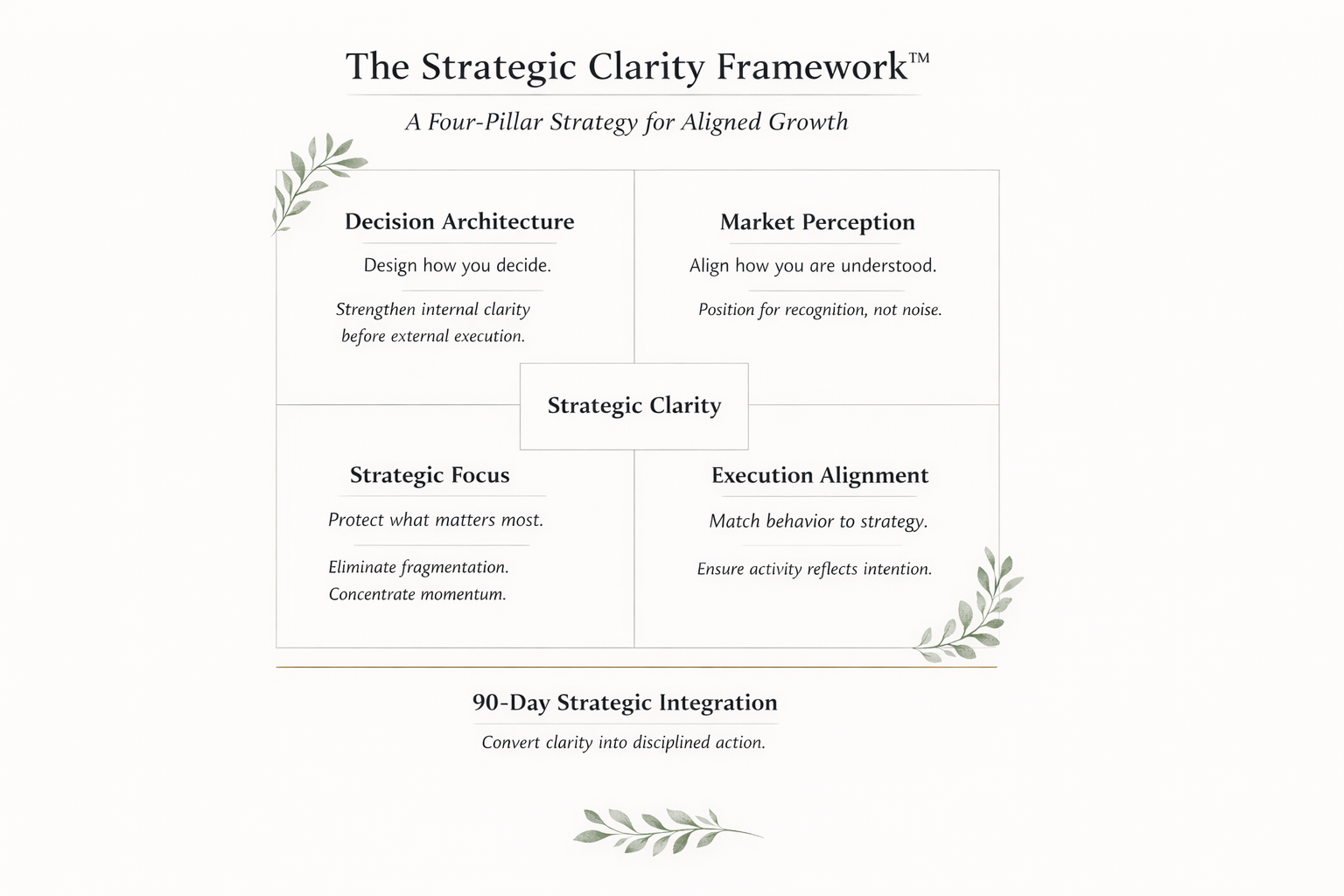
That pattern is exactly why I developed 🌿 The Strategic Clarity Framework™ 🌿 — a four-pillar model designed to eliminate fragmentation and restore aligned growth. We don’t chase tactics here. We rebuild clarity at the architectural level.

A close-up of a handwritten notebook emphasizing execution alignment and strategic focus during a business clarity session in the United States.

Are You Actually Making Decisions — Or Just Reacting?

Pillar 1: Decision Architecture

Before we touch your marketing or adjust your strategy, we examine how decisions are currently being made inside your business. Many founders are constantly executing — but operating from reactive patterns rather than intentional ones.

This pillar helps us identify:

  • What is being prioritized, and why
  • Where energy is being misallocated
  • Which assumptions are quietly driving your growth choices

When you understand the architecture of your own decision-making, everything downstream gets cleaner. Clarity begins with internal alignment.

Does Your Audience Actually Understand What Makes You Different?

Pillar 2: Market Perception

Growth stalls when your positioning is being misinterpreted by the very people you are trying to reach. This pillar analyzes how your expertise is actually being perceived by your audience — not how you intend it to be perceived.

We look at:

  • Differentiation clarity, what makes you distinct, and whether that is actually landing
  • Message alignment with buyer psychology
  • Signal versus noise positioning, are you communicating value, or contributing to the overwhelm?

You cannot fix what you cannot see. This pillar makes the invisible visible. When perception shifts, traction follows.

Is Your Overwhelm Coming From Too Little Action — Or Too Many Competing Priorities?

Pillar 3: Strategic Focus

Overwhelm is rarely caused by too little action. More often, it is caused by too many competing priorities pulling your energy in every direction at once. This pillar establishes a clear strategic hierarchy so you can move with intention rather than motion.

We determine:

  • What deserves your focus right now
  • What should be paused without guilt
  • What creates measurable leverage for where you actually want to go

Focus is not about doing less. It is about doing what matters.

Is What You Do Every Day Actually Reflecting Your Strategy?

Pillar 4: Execution Alignment

Strategy means nothing if your execution does not reflect it. This pillar brings everything together by ensuring your day-to-day actions are an accurate expression of your strategy — not just habit or momentum from how things have always been done.

We align:

  • Content direction
  • Offer refinement
  • Visibility channels
  • Growth metrics

The goal is not more activity. It is aligned activity — every action pointing in the same direction with purpose behind it.

What Makes This Framework Different From Generic Business Advice?

What sets this framework apart is that it does not just look at your business systems. It looks at you.

Drawing on dual master’s degrees in Psychology and Marketing, I dig into the psychology behind potential client behavior, but also the psychology of you as the founder. We examine your decision-making processes, what is guiding them beneath the surface, and how that aligns with your actual intentions. Because you can have a flawless strategy on paper and still sabotage the execution if your internal wiring is running a different program.

This is not about doing more. Goodness knows most of us are already putting in 60-plus hours a week. It is about doing the right things, with intention, and matching that intent in your follow-through execution.

A visual diagram outlining decision architecture, market perception, strategic focus, and execution alignment within a 90-day strategic integration model in the United States.

Who Is Going to Come Out of This Season Positioned to Win?

The business owners who come out of this season positioned for real growth are not the ones who paused and waited for things to settle. They are the ones who got quiet enough to get clear and then built with purpose while everyone else was reacting.

The work you do right now, in the hard season, is what determines where you stand when things stabilize. That can be you.

Ready to Stop Reacting and Start Building With Clarity?

If you are a founder who is tired of the noise, tired of spinning your wheels, and ready to do the work that actually moves the needle, this is where it starts.

🌿The Strategic Clarity Framework™🌿 is designed to meet you exactly where you are right now. There is no one-size-fits-all entry point, because no two businesses, and no two seasons, are the same.

🌿 Option 1: Strategy Intensive — This is where we go deep, fast. We examine your decision architecture, diagnose where fragmentation is costing you, and build a clear strategic foundation to move forward from. If you have been running on reaction and need to get grounded, this is where we begin.

🌿 Option 2: Ongoing Advisory — SEO + Business Strategy Support. Once the foundation is set, we build. This is a sustained, strategic partnership — keeping your positioning sharp, your execution aligned, and your visibility growing through integrated SEO and business strategy support.

Choose the container that fits your season:

3-Month Strategic Sprint — Focused, high-impact clarity and a clear path forward, fast.

6-Month Strategic Advisory Partnership — For founders ready to do the deeper work, build with consistency, and come out of this season positioned to lead their market.

You do not have to have it all figured out to begin. You just have to be ready to stop guessing and start building with intention.

→ Let’s Find Your Starting Point

→ Schedule a Stratgey & Fit Consultation Call Today

The work you do right now determines where you stand when the dust settles. Let’s make it count.

A professional headshot of a digital marketing and SEO consultant standing in front of green foliage, representing business strategy and growth in the United States.

About the Author

With dual master’s degrees in Psychology and Marketing, Mary sits at a rare intersection, one that allows her to see both the human and the strategic side of why businesses stall, fragment, and lose traction.

Her career has moved through three distinct but deeply connected lanes: Qualified Mental Health Professional, marketer, and small business owner. That combination is not incidental. It is the foundation of everything she brings to her work with founders. She understands the psychology driving your potential clients’ decisions. She also understands the psychology driving yours, the fear, the reactive patterns, the gap between intention and follow-through that quietly costs you growth.

Her passion is working with small business owners and founders who are done reacting and ready to build with purpose, especially in the seasons when everything around them feels uncertain.

**TL;DR:**

In today’s polarized world, fostering gratitude and empathy in the workplace is essential for navigating political unrest. Organizations should establish clear core values, encourage open dialogue, and implement anti-discrimination policies to create a respectful and inclusive environment. While hiring individuals with aligned views can enhance cohesion, embracing diverse perspectives is crucial for innovation and adaptability. Ultimately, balancing moral alignment with diversity can lead to a supportive workplace culture. By focusing on gratitude and empathy, companies can improve employee well-being and drive success. Interested in enhancing your workplace culture or exploring SEO strategies? Contact Simplified SEO Consulting to elevate your organization today!


In today’s increasingly polarized world, political unrest and intolerance have seeped into many aspects of our lives, including the workplace. As employers and employees grapple with differing views and perspectives, fostering an environment of gratitude and empathy becomes crucial. This article delves into the importance of these values during tumultuous times and addresses the question: is it okay to hire people whose views align with yours to create a cohesive work environment?

Understanding Polarization and Political Unrest in Workplace Values

To navigate the complexities of polarization, it’s essential to start by identifying core values that define your organization. These should include mutual respect, equality, and a commitment to diversity. Ensuring these values are clear, communicated, and embraced by everyone in the organization is paramount. Some principles, such as zero tolerance for discrimination or harassment, must be non-negotiable. These should be clearly stated in company policies and reflected in training programs to foster a safe and respectful environment.

In a family and employee-first environment, emphasizing a supportive, family-like atmosphere that respects every individual is vital. By nurturing this environment, organizations can ensure that personal identities and choices are respected, creating a more harmonious workplace.

People of different backgrounds standing on a bridge, holding hands and talking, representing teamwork culture, diversity and inclusion, and leading with empathy to strengthen unity and dialogue in the workplace.

Navigating Divergent Views in Challenging Political Times

Encouraging open dialogue is key to managing divergent views. Create a space where employees feel safe to express their views through workshops or open forums moderated by trained facilitators. This helps in managing sensitive discussions constructively. Education and awareness are crucial in bridging gaps between differing viewpoints. Regular training sessions focused on diversity and inclusion increase understanding and reduce prejudice, facilitating better communication.

However, it’s also critical to respect boundaries. While encouraging open dialogue, ensure that discussions around sensitive issues are handled with care, and no one feels compelled to disclose more than they are comfortable with.

Balancing Personal Political Beliefs With Professional Standards

Aligning personal beliefs with professional standards is essential. While personal beliefs are valid, employees and managers must recognize the importance of aligning with the company’s professional standards, especially in respect and inclusion. Focusing on shared goals can help shift the focus from differences to common purposes, fostering cooperation.

Implementing support systems like Employee Resource Groups (ERGs) can also be beneficial. ERGs provide safe spaces for underrepresented groups to discuss and address unique issues, enhancing the support structure within the workplace

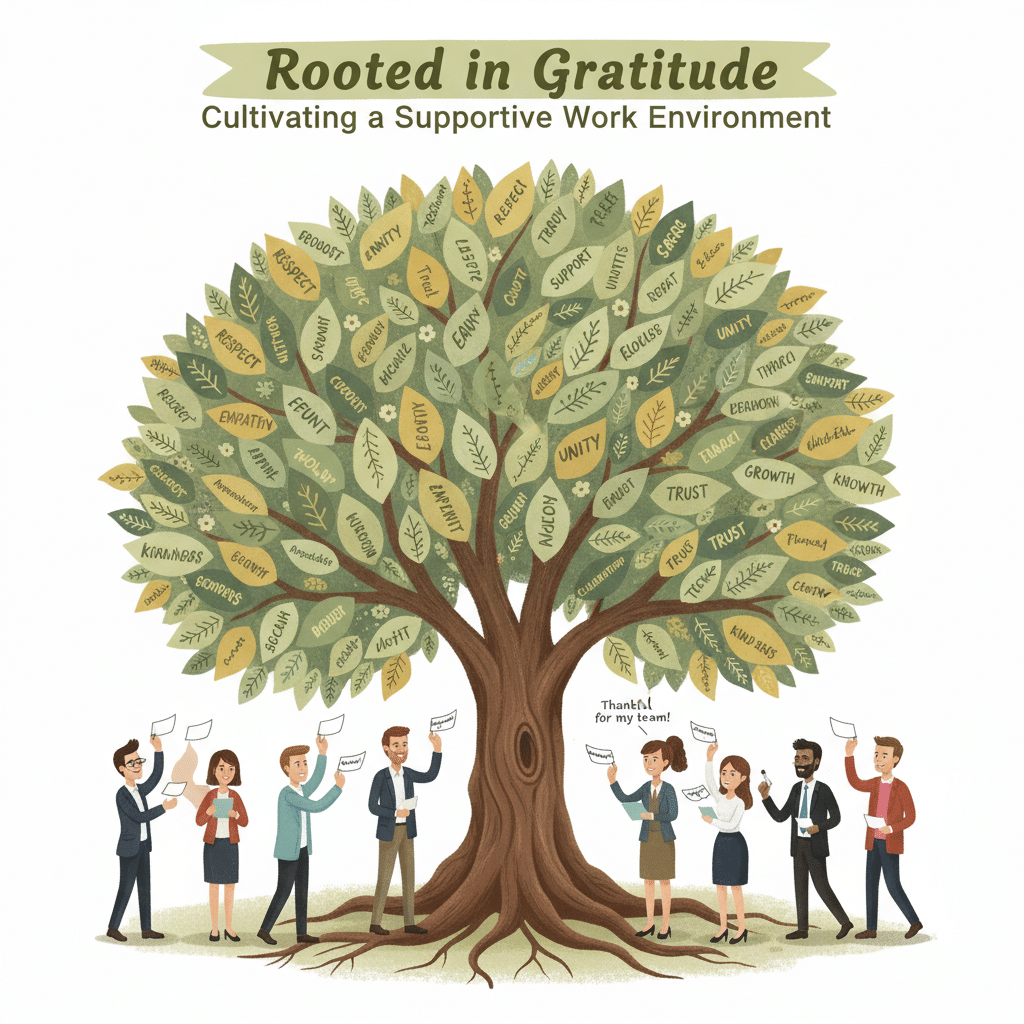
Illustration of a large tree with leaves labeled with positive workplace values like empathy, trust, and unity. People below celebrate teamwork culture and leading with gratitude to nurture cohesion in the workplace.

The Power of Gratitude in Challenging Times

Gratitude goes beyond a fleeting emotion; it’s a powerful tool that aids in navigating difficult conversations and situations. As political tensions rise, expressing gratitude creates significant positive changes. It improves mental well-being by providing relief from stress and anxiety, fosters connection by recognizing the contributions of those around us, and strengthens relationships among colleagues with differing viewpoints. Gratitude also enhances team morale, uplifting spirits, and promoting unity.

Empathy: The Cornerstone of Understanding

Empathy acts as a bridge between conflicting perspectives. By embedding empathy within workplace culture, organizations can benefit greatly. Encouraging open dialogue and creating safe spaces for discussions allow employees to share their viewpoints without fear of judgment. This openness promotes inclusivity, ensuring everyone feels valued and respected. Furthermore, when team members empathize with one another, they focus on common goals rather than differences, facilitating a more harmonious and effective workplace.

Implementing Policies and Procedures

Clear anti-discrimination policies must be established and enforced to ensure a safe workplace. Make sure all employees are aware of these policies and the consequences of violating them. Develop responsive conflict resolution mechanisms for resolving conflicts arising from differing views, such as mediation by a neutral third party. Regular policy reviews are necessary to reflect changing societal norms and continue fostering a respectful, inclusive workplace.

Leadership and culture play crucial roles. Leaders must exemplify the values of respect and inclusion, setting the tone for the rest of the organization. Promoting a culture of empathy where employees put themselves in others’ shoes is essential. Recognize and celebrate diversity through events and initiatives that honor various cultures and identities, reinforcing the value of every employee.

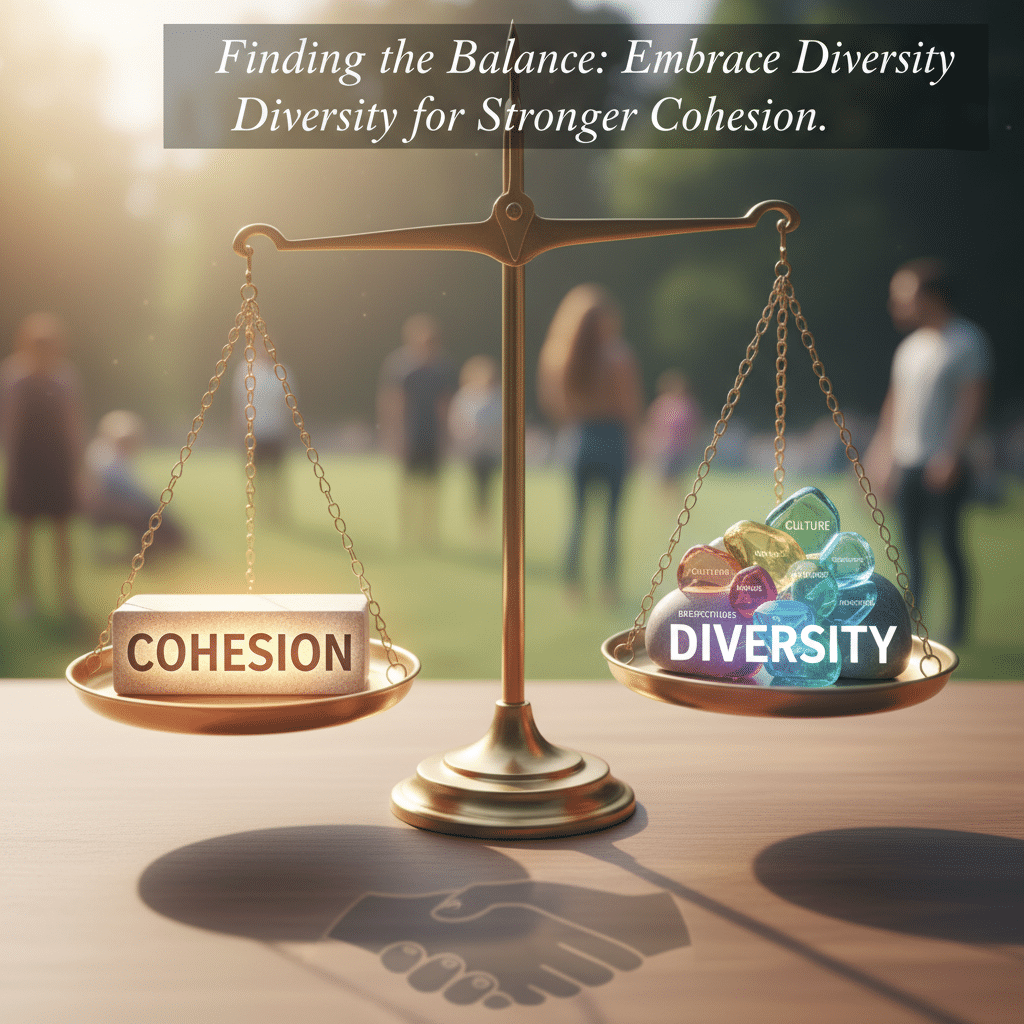
A balanced scale shows “Cohesion” on one side and “Diversity” on the other, symbolizing the harmony between diversity and inclusion, teamwork culture, and cohesion in the workplace through empathy and understanding.

The Political Dilemma: Hiring For Cohesion vs. Diversity

A common question in creating a supportive work environment is whether it’s acceptable to hire individuals whose views align with yours. While it might seem easier to create a homogenous workplace to avoid conflict, it’s essential to consider the long-term implications.

The Case for Cohesion: 

Hiring for alignment can enhance smoother communication, reduce misunderstandings and friction, and increase team unity. It can also streamline decision-making and strategic planning, leading to increased productivity.

The Case for Diversity: 

The benefits of embracing diverse perspectives are profound. A team with varied viewpoints is more likely to generate innovative solutions and ideas. Exposure to differing opinions fosters adaptability and resilience among employees when facing challenges. Additionally, a diverse workforce can better understand and cater to a wider range of customers and clients.

The Case for Moral Alignment:

While diversity in perspectives and ideas is crucial, hiring for morally aligned viewpoints can be equally profound. In this context, moral alignment refers to shared ethical standards and political values, not a reduction in diversity of thought or innovation. Such alignment can lay a strong foundation for a cohesive workplace culture where team members feel a deep sense of connection to the organization’s mission and values.

When employees share common moral and ethical principles, it fosters a sense of trust and integrity within the team. This shared understanding reduces conflicts arising from fundamental value differences, allowing individuals to focus their energy on collaboration and creativity. Moreover, aligning politically, when it pertains to core values such as social justice, equality, and environmental responsibility, can lead to a more unified approach in addressing societal issues through the organization’s work.

Moral alignment can also enhance employee satisfaction and retention. When individuals feel that their personal values are mirrored in their professional environment, they are more likely to remain engaged and committed to the organization. This can lead to higher morale, less turnover, and a stronger organizational identity.

Furthermore, a team unified by shared ethics can collaboratively tackle ethical dilemmas that arise in business practices, ensuring that the organization consistently acts in accordance with its moral compass. This alignment doesn’t negate diversity; rather, it complements it, ensuring a balance of varied perspectives united by shared foundational values.

The Path Forward: Finding Cohesion and Support Through Empathy and Gratitude

In times of political unrest and intolerance, leaning into gratitude and empathy can transform your workplace into a supportive and cohesive environment. By fostering open dialogue and embracing diverse perspectives, not only do you enhance employee well-being, but you also drive organizational success. Remember, while it may be tempting to surround yourself with like-minded individuals, the strength of your team lies in its diversity. Embrace it, nurture it, and watch your organization thrive.

Take the Next Step Towards a Thriving Workplace Built on Empathy

If you’re interested in learning how to create a positive workplace culture or want to explore SEO topics that can help your business grow, now is the perfect time to reach out. At Simplified SEO Consulting, we’re dedicated to simplifying SEO and empowering professionals like you to succeed in an ever-changing landscape. Let us help you elevate your organization’s culture and online presence to new heights. Contact us today to begin your journey toward a more inclusive, effective, and successful workplace.

About the Author

As a passionate advocate for workplace inclusivity and cultural transformation, Mary Walker brings a wealth of experience in helping organizations navigate the complexities of political unrest and intolerance. With a focus on fostering environments rich in gratitude and empathy, Mary believes that true success stems from embracing both cohesion and diversity. Her insights are grounded in years of hands-on experience in promoting mutual respect, equality, and ethical alignment within diverse teams.

In her work, Mary has seen the transformative power of empathy in action, turning conflict into connection and helping organizations thrive even in challenging times. Through blogging, consulting, and in-depth workshops, she educates and inspires leaders to prioritize employee well-being and open dialogue.

With a commitment to continuous learning and adaptation, Mary collaborates with businesses to implement innovative practices that align personal and professional values with the overarching mission of the organization. At Simplified SEO Consulting, she is dedicated to demystifying SEO and equipping businesses with the tools needed for growth in an ever-evolving digital landscape.

Driven by a vision of inclusive and supportive work environments, Mary emphasizes the importance of both diversity and moral alignment, helping companies build cultures that are both ethically grounded and innovative. Whether you’re looking to refine your company’s cultural strategies or enhance your online presence, Mary is your guide to creating a more cohesive and effective workplace. Embrace diversity, nurture it, and see your organization not only survive but thrive.

**TL;DR:**

Building trust in remote teams is crucial, especially during the holidays when emotional challenges can arise. Simplified SEO Consulting emphasizes genuine connections over productivity, advocating for weekly check-ins, casual “Water Cooler Hours,” and quarterly one-on-ones to foster open communication. In-person gatherings, like team retreats, enhance relationships further. Leaders should prioritize empathy and support to create a safe workplace culture, leading to improved engagement and team loyalty. Ultimately, investing in relationships rather than superficial perks is key to a thriving remote team.

Investing in Your Team As You Head Into the Holiday Season

As we head into the holiday season—a time of giving, gratitude, and a little extra chaos—it’s easy to focus on external things: client deliverables, year-end marketing pushes, and what kind of virtual holiday celebration we’re going to pull off for our teams. But at Simplified SEO Consulting, we’ve learned that building trust in remote teams is one of the most valuable investments a leader can make—especially during the holidays. Because real connection doesn’t come from productivity tools or scheduled check-ins; it comes from genuine care, consistency, and emotional presence.

What if the real work we need to be doing this time of year isn’t about productivity at all?

What if the most impactful thing you could do as a leader right now is this: ask your team how they’re really doing—and mean it.

We’re a fully remote team that relies on tools like Zoom, Slack, and Asana to stay connected and aligned. But we’ve learned that remote efficiency only works when it’s balanced with emotional connection. Especially during the holidays—when life is heavier, more complicated, and often lonelier—we believe connection becomes the foundation for everything else.

This blog is about how we intentionally build that connection: through weekly rituals, casual chats, structured support, and big-picture team culture. And it’s an invitation to other leaders—whether you manage a team of two or twenty—to move beyond surface-level “treats” and into something far more meaningful: trust.

A festive display representing Halloween, Thanksgiving, Christmas, and New Year’s celebrations—capturing the warmth of small business leadership and remote teamwork through connection and gratitude.

Why Emotional Intelligence Is the Key to Building Trust in Remote Teams During the Holidays

Holidays can be a joyful time—but they can also bring grief, financial strain, increased pressure, and feelings of isolation, especially in a remote work setting. People may be managing caregiving responsibilities, navigating difficult family dynamics, or simply feeling the fatigue of a long year.

And while your team might still be showing up with their cameras on and task lists checked off, it’s important to remember: people don’t stop being human just because we’re wrapping up Q4.

That’s why now is the time to lean into authentic leadership—to build space for people to be real. To shift your focus from performance alone to presence, empathy, and care.

How We Build a Culture of Trust in Our Remote Team

Weekly Check-Ins: A Simple Way to Build Trust in Remote Teams

Every week, our team comes together not just to talk about metrics, projects, or client wins—but to talk about life. We start each meeting with a simple check-in: “How are you doing?” And we don’t mean the polite, automatic kind. We mean the real version.

Sometimes team members share exciting news—family visits, holidays coming up, personal wins. Other times, they’re honest about feeling overwhelmed, tired, or just “off.” And that’s okay.

We’ve made it normal to say, “I’m not at 100% today.” And that normalization is powerful. Because when your people know they can be honest without judgment, they bring more of themselves to their work—and they trust that the team has their back.

Tip for Other Leaders:

 Start your next meeting with this prompt:

“What’s one word to describe how you’re feeling today?”
Then pause, let people answer, and listen—without jumping in to fix.

A computer screen showing four culturally diverse professionals smiling during a virtual meeting, symbolizing remote team trust building and strong small business leadership.

Monthly Water Cooler Hours: Strengthening Remote Team Connection Beyond Work

Remote work is efficient, but it can get… sterile. That’s why once a month, we hold space for pure fun. Our “Water Cooler Hour” is a no-pressure Zoom hangout where team members can play games, chat, laugh, or just be together.

There’s no agenda. No presentations. Just connection.

These casual moments allow people to drop their “work hats” and show up as themselves. That might mean talking about their dog’s new haircut, a Netflix show they’re obsessed with, or a hobby we didn’t know they had.

These social hours build friendships, not just work alliances. And those relationships pay dividends when challenges arise later.

Tip for Other Leaders:

Don’t overthink it. Try:

  • A 30-minute monthly “Show & Tell”
  • “Two Truths and a Lie” or trivia night
  • A virtual recipe swap or pet parade

Quarterly 1:1s: Building Trust Through Authentic Leadership in Remote Teams

Each quarter, we set aside intentional time to meet with every individual on our team. These aren’t your traditional performance reviews—they’re conversations rooted in curiosity, support, and long-term growth.

We ask questions like:

  • What are you proud of from the past few months?
  • What’s been hard?
  • Where do you want to grow?
  • What do you need from leadership right now?

These meetings honor both professional development and emotional wellbeing. They also help us as leaders stay grounded in what each person values and needs.

When people feel seen in their individual experience, they become more engaged in the collective mission.

Tip for Other Leaders:

Create a shared doc with prompts and space for notes. The most powerful moments often come from follow-up:

“Last time you said this was hard—how’s that going now?”

A diverse small business team connects in person at a cozy coffee shop, enjoying coffee and conversation that strengthen remote teamwork and leadership goals.

Why In-Person Moments Still Matter When Building Trust in Remote Teams

Each year, we do something special: we take a team cruise. No laptops. No strategy sessions. Just real-world connection.

While we work hard all year remotely, this in-person experience reminds us that we’re more than job titles and email signatures—we’re people who care deeply about one another.

Not every team can do a cruise, but the intention behind it matters most. It’s about stepping away from the screen and into shared experience. It’s about celebrating the team behind the success.

Tip for Other Leaders:

Think about what kind of retreat, local meetup, or “virtual getaway” you could organize—even on a small scale. The return on connection is worth it.

The Ripple Effect: What Happens When You Lead Remote Teams With Trust First

When we say “team culture,” we don’t just mean having a mission statement or Slack emojis. We mean creating an environment where people are safe to show up as themselves.

We’ve seen the impact firsthand:

  • Team members who feel supported are more likely to ask for help—preventing burnout and missed deadlines.
  • Honesty becomes normalized—so small problems don’t become big ones.
  • People stay longer, show up more fully, and build stronger client relationships because they feel rooted in something bigger than just a paycheck.

In short: kindness, curiosity, and consistency build the kind of workplace people want to be part of.

Don’t Just Offer Perks—Build Real Trust in Your Remote Team

The holidays are filled with surface-level “treats.” End-of-year bonuses. Gift cards. Pep talks. And while those things are nice—they’re not enough.

What your team really needs is to know that you care about them as people. That when the goals feel heavy or life gets messy, they can be honest—and still be supported.

At Simplified SEO Consulting, we believe that trust isn’t a perk—it’s a pillar. And as we close out another year, we’re doubling down on what matters most: relationships.

So wherever you are as a leader—whether you’re just starting to build a team or managing a growing remote company—we hope this blog gives you permission to lead with heart.

Because when you take care of your people, they take care of everything else.

Start Building a Trust-Based Remote Team Culture Today

Whether you’re a solo practice owner starting to grow your team or a seasoned leader managing a fully remote business, the culture you build matters. You don’t have to be perfect, and you don’t need a cruise budget or an HR department—you just need to be intentional.

Start small:

  • Check in with your people.
  • Listen when they speak.
  • Celebrate their wins—and support them in the hard stuff.

And if you’re looking to grow a people-first business that’s rooted in connection and strategy, we’d love to walk alongside you. At Simplified SEO Consulting, we’re passionate about building ethical, human-centered businesses—and that includes our own.

Reach out to us at simplifiedseoconsulting.com to learn more about our services, our team, or our culture—or just to start a conversation about what’s possible when you lead with empathy.

Mary Walker headshot in an office setting. As the owner of Simplified SEO Consulting its her mission to help you get to the top of the SEO rankings.

About the Author

Mary Emily Walker is the owner of Simplified SEO Consulting and a passionate advocate for heart-led leadership in the digital world. With dual master’s degrees in Psychology and Digital Marketing, she brings a unique perspective to team culture, growth strategy, and client-centered SEO.

A proud mom of five and lifelong learner, Mary believes that real business success is rooted in authenticity, empathy, and relationships. She leads her remote team like a family—prioritizing trust, communication, and shared joy—and works with private practice owners and helping professionals to do the same in their own businesses.

When she’s not mentoring her team or teaching SEO, you’ll find Mary crocheting, reading, or enjoying football with her family in rural Missouri.

That’s the Life Question We’re Exploring Today

If you’re a small business leader, you’ve likely faced the long to-do lists, the constant mental load, and the guilt that creeps in when you try to rest — all while knowing the work doesn’t stop. In this post, I’m diving into what balance looks like (and what it doesn’t), how we can support each other as leaders, and the small ways we’re redefining success beyond the grind.

A watercolor illustration of a small business owner working on a laptop in a cozy home office, surrounded by books and plants, capturing a moment of peaceful productivity and intentional work-life balance.

My Life Journey from Team Member to Business Owner

My path to becoming a small business owner has been anything but traditional.

I started at Simplified SEO Consulting as an SEO Specialist — working directly with clients to optimize their websites and improve search engine visibility. I often carried a full caseload (and then some), helping business owners grow their online presence. Unexpectedly, the company came up for sale. Owning a small business had always been a dream of mine, so my husband and I sat down, crunched the numbers, and made the leap. We reached out to the previous owner, expressed our interest, and within months, we became the new owners of Simplified SEO Consulting.

That shift — from team member to team leader — was enormous. Overnight, I became responsible not just for my work, but for the entire business. I was working 18-hour days, learning the systems, understanding what needed to change, and making key decisions that affected the entire team. It impacted my family life dramatically at first.

I was afraid this intense pace would become my new reality. Thankfully, with time, structure, and trust, I’ve found a rhythm that lets me lead, serve clients, and still spend meaningful time with my family.

Why Life Balance Is So Hard in Leadership

The Constant Mental Load

Even when I’m not actively working, my brain doesn’t stop. I’m always tracking client needs, deadlines, internal improvements, and how my team is doing. That ever-present dialogue is one of the hardest parts of leadership — and the hardest to turn off.

Emotional Responsibility

Leadership means steering the ship and making sure no one falls overboard. I’m responsible not only for my family’s livelihood, but also for my employees’ well-being and the success of our clients. That emotional weight is heavy, and it doesn’t end at 5 p.m.

Guilt When Resting

I struggle with the belief that if I’m not constantly available, something might fall apart. That guilt shows up when I try to rest, spend time with family, or even sleep. It’s hard to be present when a part of me is always checking for problems, emails, or things I might be missing.

Invisible Labor

There’s a layer of work that’s hard to see: the emotional regulation, the mental tracking, the check-ins with team members and clients. These leadership tasks don’t always get credit, but they are essential — and exhausting.

A warm living room scene with a football game on TV, a coffee mug, and an open book — symbolizing how small business owners can create work-life balance through simple personal rituals and downtime.

What I’ve Learned (and Continue to Learn)

Redefining Success

Success used to mean doing as much as possible, often working multiple jobs, burning the candle at both ends. But that approach led to emotional exhaustion, fatigue, and frustration. Now, I’m learning to define success differently — with balance at the center.

Success for me today means:

  • Time with my family
  • Space to rest and reflect
  • A job I love that doesn’t demand every ounce of my energy

My value isn’t measured by how much I produce — it’s defined by who I am and how I show up in the world.

Work – Life Boundaries as Leadership Tools

At Simplified SEO Consulting, we don’t just talk about boundaries — we live them.
We protect weekends. We don’t expect anyone to be “on” after work hours. We offer flexible schedules and prioritize work-life balance for every team member, including me. These boundaries aren’t just for our employees — they’re necessary for me as a leader, too.

Delegating with Trust

I’ve had to overcome the urge to “just do it myself.” I work with the most talented, capable team, and learning to delegate based on their strengths has been freeing. It’s still something I work on, but trusting my team to make decisions has allowed me to grow both personally and professionally.

Rest Is a Leadership Practice

Rest doesn’t always look like a vacation. Sometimes, it’s a quiet afternoon when the kids are out, a favorite movie, or a walk with music. These small acts of self-care are vital. Rest helps me reset so I can lead with clarity and compassion.

A woman sits peacefully on a porch reading a book at sunset, representing a small business owner embracing work-life balance through simple, restful moments outside of work.

How We Support Each Other at Simplified SEO Consulting

Transparency and Emotional Check-Ins

We start every Monday team meeting by asking, “How are you? Where are you at? How can we help?”
We believe emotional well-being matters more than metrics. If our team members aren’t okay, they can’t show up fully for their work — and we honor that. We provide resources, paid mental health days, and offer space for vulnerability.

Role Alignment and Passion Projects

Each team member at Simplified SEO Consulting has a defined role and a unique area of passion they can explore. Whether that’s technical SEO, social media, or consulting, we encourage our team to pursue what excites them. We support continued education through certifications and learning opportunities to help them grow.

Trust as the Foundation

Our team operates on a foundation of trust. There’s no drama, no infighting — just respect, support, and shared commitment. We’ve even gone on cruises together! That kind of connection isn’t accidental; it’s built intentionally, and I’m proud of it.

What “Having a Life” Looks Like for Me

For me, having a life doesn’t mean jetting off on some luxurious vacation (though I wouldn’t say no to one!). It means I get to enjoy the simple, everyday moments I love — without feeling guilty.

  • It’s being able to sit down on a Sunday and watch football with my family, fully present and relaxed.
  • It’s pulling out my yarn and crocheting something just because I enjoy it — not because it’s productive.
  • It’s picking up a book and getting lost in it, not checking the clock or my email every few minutes.
  • It’s being at my kids’ events and actually soaking it in — cheering, laughing, and taking photos — instead of feeling like I “should” be doing something else.

There were times when I felt like I had to earn those moments, or justify them to myself. But I’ve learned those are the moments that make my life feel meaningful. Those are the moments that remind me who I am outside of the business — and when I allow myself to enjoy them, I don’t just get through the week… I actually live it.

A warm living room scene with a football game on TV, a coffee mug, and an open book — symbolizing how small business owners can create work-life balance through simple personal rituals and downtime.

Closing Thoughts: You Don’t Have to Grind to Lead Well

Here’s the truth: balance doesn’t magically happen. It’s not something that falls in your lap one day when the stars align. It takes intentional choices — boundaries, support, and a whole lot of reminders to yourself that you’re allowed to slow down.

As small business owners, we need to remember: we didn’t build our businesses just to burn ourselves out in them. I didn’t come to Simplified SEO Consulting so I could grind every day until I dropped. My goal is to create something meaningful — and I’ve realized I get to define what that looks like.

And for me, success looks like being able to lead with integrity and still have space to live my life. I truly believe we don’t have to hustle ourselves into the ground to lead well. In fact, the more rested and centered I am, the better I lead.

So I’ll leave you with two questions to reflect on:

  • What areas of your life have you unintentionally sacrificed to keep the business afloat?
  • And what might you be able to reclaim if you asked for more support — or gave yourself permission to redefine success on your terms?

Mary Walker, owner of Simplified SEO Consulting shares tips and ideas on how to stay relevant with SEO strategies in an ever changing world.


About the Author

Mary Walker is the owner of Simplified SEO Consulting, where she leads with empathy, strategy, and a strong belief that sustainable success is built through collaboration. As a small business owner herself, Mary knows firsthand how challenging it can be to balance leadership with real life — which is why she’s created a company culture rooted in psychological safety, teamwork, and mutual support.

With Master’s degrees in Digital Marketing and Psychology, Mary blends a deep understanding of human behavior with effective, data-driven SEO strategies. But for her, success isn’t just about higher rankings — it’s about helping others grow with confidence, clarity, and purpose.

When she’s not mentoring her team or supporting clients, Mary is likely cheering on her favorite football teams, spending time with her five kids, or crocheting her way to a moment of calm. She’s passionate about showing that it’s not only possible to lead well and live well — it’s essential.

Listen to our From Keywords to Connections Podcast: Can You Lead a Business and Still Have a Life, Here

In American work culture, individual achievement, not collaborative, is often celebrated above all else.

We idolize the lone innovator who pulls off the impossible, the standout performer who crushes every metric, and the “rockstar” who seems to operate on an entirely different level. These narratives are compelling — and sometimes even inspiring — but they can also be misleading.

Because here’s the truth:

Sustainable success doesn’t come from individual brilliance alone. It comes from teams that know how to collaborate, support one another, and grow together.

The longer I’ve led teams and worked across organizations, the more I’ve seen this lesson repeat itself. The most resilient, innovative, and high-performing companies aren’t those with the flashiest stars — they’re the ones where the whole team shines.

A solitary golden trophy on a pedestal, symbolizing the limits of success without a collaborative workplace culture.

What Is an Individualistic Mindset and How Does It Show Up at Work?

An individualistic mindset places value on personal success, often at the expense of collective achievement. It shows up in subtle ways, like employees feeling the need to compete rather than collaborate, or team members withholding ideas because they don’t want someone else to “steal the spotlight.”

This mindset can be reinforced through workplace norms: performance reviews focused on solo metrics, promotions awarded to those who stand out rather than those who lift others up, or cultures where people hesitate to ask for help for fear of seeming weak or unqualified.

While personal accountability is important, overemphasis on individualism leads to silos, internal competition, and eventually, burnout. The organization suffers not because employees aren’t capable, but because they’re not encouraged or empowered to work together.

What Are the Risks of a “Me First” Culture in the Workplace?

1. Innovation Gets Stuck Without Collaboration

When employees are afraid to share ideas unless they’re fully polished or guaranteed to succeed, innovation slows down. Creative problem-solving thrives in environments where people feel free to brainstorm without judgment — and that only happens in collaborative cultures.

In individualistic environments, there’s a fear of failure that paralyzes teams. If mistakes are punished instead of treated as learning opportunities, people will opt to stay safe instead of think big.

2. Communication Breaks Down

In a team-first culture, information flows freely. People are quick to share what they’re learning, what’s not working, and where they need help. But in an individual-first setting, communication becomes transactional, competitive, or worse — nonexistent.

This breakdown leads to duplicated work, missed opportunities, and disconnection across departments. When collaboration is weak, even the most talented individuals struggle to move the organization forward.

3. Employees Burn Out When a Collaborative Mindset is Frowned Upon

When success feels like a solo pursuit, work becomes a race to prove one’s worth. That pressure, over time, leads to fatigue, disengagement, and turnover. Employees in these cultures often feel isolated, unseen, and overburdened.

On the other hand, collaborative cultures foster mutual support. When people feel like they’re part of something bigger — a shared mission, a cohesive team — they’re more likely to stay engaged and resilient through challenges.

A dimly lit desk cluttered with papers and a glowing laptop, highlighting the stress of non-collaborative work environments.

What Does a Collaborative Workplace Actually Look Like?

A truly collaborative workplace isn’t just about having more team meetings or Slack channels. It’s about building a culture where everyone feels ownership over shared goals and support in their individual roles.

Here are a few key features of collaborative environments — and how they shift daily work:

People Feel Safe Sharing Ideas in a Collaborative Environment 

In a collaborative team, there’s no such thing as a “stupid question.” Employees trust that their perspectives matter, and that speaking up won’t lead to ridicule or rejection. This psychological safety opens the door for creativity, constructive debate, and breakthrough thinking.

Managers play a critical role in modeling this. When leaders openly ask questions, invite input, and admit their own blind spots, it creates permission for others to do the same.

Mistakes Become Growth Moments

Instead of punishing failure, collaborative cultures treat mistakes as opportunities to learn. Postmortems become conversations about what can be improved — not who can be blamed.

This approach encourages experimentation and risk-taking. When people aren’t afraid of repercussions, they’re more likely to try new things, innovate, and iterate toward success.

Work Feels Meaningful, Not Just Demanding

In a healthy team dynamic, work is more than survival — it’s contribution. People feel that their efforts matter not just to their own success, but to the team’s success. That sense of purpose fuels motivation, commitment, and even joy.

When the focus shifts from “How can I get ahead?” to “How can we move forward together?” it changes the energy of the workplace.

Colorful interlocking gears painted in watercolor, representing a collaborative system where every part works together.

How Can Leaders Foster a More Collaborative Culture?

Transforming a workplace from individual-driven to team-oriented doesn’t happen overnight. It requires consistent effort, trust-building, and leadership that prioritizes how people work together just as much as what they produce.

Here are 10 evidence-backed practices that can help:

1. Treat Mistakes as Learning Opportunities

Instead of asking “Who messed up?” ask “What can we learn from this?” Teams grow faster when failure is met with curiosity instead of criticism.

2. Use Technology to Stay Connected

Remote and hybrid teams thrive on tools that foster real-time collaboration, like Slack, Asana, Notion, or Microsoft Teams. But it’s not just about the tools — it’s about using them in ways that promote transparency and responsiveness.

3. Encourage Openness and Transparency to Foster Collaborative Connections

Keep people in the loop on key decisions and strategy shifts. When team members understand the bigger picture, they’re more likely to align their work and voice helpful ideas.

4. Measure, Adapt, and Improve

Collect feedback regularly — through surveys, retrospectives, or one-on-ones — and act on it. Showing your team that their voices lead to real change builds trust and buy-in.

5. Offer Team-Based Incentives

While individual rewards are fine, also celebrate collective wins. Recognize entire departments for hitting milestones, solving complex problems, or improving cross-team collaboration.

6. Communicate Expectations Clearly

Don’t assume your team knows what collaboration “should” look like. Define it. Model it. Talk about what successful teamwork looks like in your specific context.

7. Create Safe Spaces for Idea Sharing 

Host brainstorming sessions where everyone has a chance to contribute, regardless of seniority or department. Use breakout groups or anonymous submissions to ensure diverse input.

8. Practice Healthy Conflict Resolution

Disagreements are normal — and often necessary for innovation. Equip your team with tools to navigate tension respectfully, focusing on issues instead of personal attacks.

9. Lead by Example

If leaders operate in silos, others will follow suit. Show your team what collaboration looks like by inviting feedback, giving credit generously, and building cross-functional relationships.

10. Invest in Employee Growth

Provide mentorship, skill development, and growth pathways. When people feel supported in their career journeys, they’re more likely to invest in the growth of others, too.

A small group of professionals collaborating around a table, capturing the energy and connection of a healthy collaborative culture.

What Are the Benefits of Shifting to a Team-First, Collaborative Culture?

The payoff for prioritizing collaboration isn’t just feel-good — it’s strategic. Organizations that foster teamwork and trust see measurable improvements across key areas:

  • Stronger cohesion: Teams develop a shared identity and trust that fuels performance.
  • Better work quality: Diverse input leads to smarter decisions and fewer blind spots.
  • Resilience during challenges: Teams with psychological safety adapt faster and support each other under pressure.
  • Higher satisfaction and retention: People stay longer when they feel valued and connected to a community. 

Where Can You Start Today?

If your team is struggling with competition, disengagement, or poor communication, ask yourself:

What’s one simple step I can take to build a more collaborative culture?

It could be as small as shifting the language you use in meetings (“we” instead of “I”), or as strategic as reworking your performance reviews to include team impact.

Start where you are. Be consistent. And know that your efforts are planting seeds for a healthier, more human workplace.

Let’s Build Workplaces Where a Collaborative Mindset Isn’t the Exception — It’s the Expectation.

Individual brilliance will always have a place in business. But in today’s complex, fast-moving work environment, it’s no longer enough.

If we want organizations that last — ones that innovate, adapt, and uplift the people within them — we need to move from me to we.

At Simplified SEO Consulting, we’ve embraced this truth by fostering a deeply collaborative culture. We take a team-based approach to nearly everything we do — from strategy to execution — because we know the best ideas and outcomes come from shared effort. Our team connects weekly over Zoom to align and encourage one another, gathers in person when we can, and intentionally creates a safe environment for both sharing ideas and expressing honest feelings. That psychological safety isn’t just a buzzword for us — it’s a foundational part of how we work, support one another, and grow together.

Mary Walker, owner of Simplified SEO Consulting shares tips and ideas on how to stay relevant with SEO strategies in an ever changing world.


About the Author

Mary Walker is the owner of Simplified SEO Consulting, where she leads a team dedicated to helping small businesses and private practice owners grow sustainably through strategic, people-centered search engine optimization. Mary believes that truly effective SEO doesn’t happen in isolation — it thrives in a collaborative environment. That’s why she’s built a company culture grounded in teamwork, psychological safety, and shared purpose.

With Master’s degrees in both Digital Marketing and Psychology, Mary brings a rare blend of strategic insight and human understanding to the digital world. Her approach to SEO combines data-driven methods with a deep respect for authenticity, connection, and the real people behind every business.

Whether she’s guiding her team, supporting clients, or refining SEO strategies, Mary is always working to foster growth — not just in search rankings, but in confidence, community, and collaboration. When she’s not working, you’ll find her cheering on her favorite football teams, spending time with her five kids, or getting creative through crocheting.

Introduction: AI Is Everywhere—But Should It Run Your SEO?

Over the past two years, artificial intelligence has moved from a futuristic buzzword to a daily reality for many business owners. From ChatGPT and Jasper to SurferSEO and RankMath, AI-powered tools promise to streamline marketing tasks, generate endless content, and even optimize websites with minimal effort.

Understandably, many small business owners are asking:

Does this mean SEO is now as simple as clicking a button?

Can a machine really understand what makes my brand unique, or what my audience needs?

The short answer is that AI can be an incredibly helpful tool in your SEO toolkit, but it is not a replacement for thoughtful human strategy, experience, or the authentic connections that drive real results.

If you’ve read my previous articles like Content Is Still King, It Just Looks a Little Different or Can AI Replace SEO?, you already know that while technology evolves, the foundational principles of SEO remain remarkably consistent. Businesses that win in search results are those that combine strategic use of tools with clear, helpful content and a commitment to serving their audience.

In this article, we’ll break down exactly what AI can—and cannot—do for your SEO in 2025, how to use these tools responsibly, and why your expertise will always be your most valuable asset.

A business professional in a blue suit sits at a desk with a laptop and notepad, working on SEO strategy as a friendly robot offers keyword ideas displayed on a digital screen. The image represents small business owners in California, Texas, New York, and Florida using artificial intelligence tools to improve search engine optimization.

What AI Can Do Well in SEO

The benefits of AI for small business marketing are real. Used thoughtfully, machine learning can save you hours of time and help you maintain consistency in your content and technical optimization.

Here are several areas where AI tools shine:

Content Ideation and Research

AI excels at quickly analyzing large volumes of data and suggesting topics that align with search demand. For example, if you want to know what people are asking about “therapy for anxiety,” AI-powered keyword research tools can generate dozens of related queries and subtopics you might not have thought to target.

First-Draft Generation

One of the most common uses of AI in SEO is to create first drafts of blog posts, meta descriptions, or service page outlines. This can dramatically reduce the time it takes to go from idea to published content. For example, you can prompt an AI writing tool to produce a 1,000-word draft about “common myths about EMDR therapy,” then refine it to match your expertise and tone.

Data Analysis and Reporting

Many AI-powered platforms can summarize Google Search Console data, track keyword rankings, and identify technical issues like broken links or slow-loading pages. Rather than spending hours combing through spreadsheets, you can review concise, AI-generated reports highlighting what’s working and what needs improvement.

On-Page Optimization Suggestions

Tools like SurferSEO and Clearscope use AI to recommend keyword density, related terms, and readability improvements to help your content be more competitive in search results. For many small businesses, these tools are useful guides to ensure your content is comprehensive and structured clearly.

Repetitive Task Automation

AI can handle tasks like generating alt text for images, creating title tag variations, and identifying duplicate content across your site. By automating these routine items, you can focus on strategic decision-making and creative work.

While these capabilities are powerful, it’s important to remember that relying solely on AI can create problems if you don’t carefully oversee and adjust its output.

A split-screen illustration showing a robot hand typing AI-generated content on a laptop on the left side, and a human hand writing thoughtfully in a notebook with a heart symbol above it on the right side. The image symbolizes the balance between artificial intelligence and authentic human writing for businesses in California, Texas, New York, and Florida.

What AI Cannot Do—And Why Human Strategy Still Wins

Despite the many ways AI can improve efficiency, there are critical aspects of SEO that still require human expertise. Machines may be able to approximate language, but they cannot replicate experience, judgment, or authentic connection.

Understanding Nuanced Search Intent

AI is trained on massive datasets, but it often struggles to distinguish between subtly different user intents. For example, the search phrase “trauma therapy” could be informational (someone learning about it), transactional (someone seeking a therapist), or navigational (someone trying to find a specific provider). Crafting content that directly addresses your prospective client’s intent requires empathy and insight into your audience’s unique challenges.

Creating Truly Original, Authoritative Content

While AI can reorganize and rephrase existing information, it does not have lived experience. It cannot generate original research, case studies, or professional insights that build authority and trust. Google’s guidelines make it clear that experience and expertise are central to ranking, especially in topics that impact people’s health, finances, or well-being.

Capturing Your Brand Voice

No matter how advanced the model, AI cannot fully replicate the unique style, tone, and personality that set your business apart. This is particularly important in relationship-driven fields like therapy, coaching, and healthcare. When prospects read your website, they are looking for reassurance that you understand their needs and that your approach resonates with them.

Ensuring Ethical and Accurate Information

AI sometimes produces content that sounds plausible but is factually incorrect or misleading. This is especially risky in regulated fields. Without thorough human review, you could accidentally publish inaccuracies that damage your reputation or even lead to compliance issues.

Adapting to Local and Cultural Context

AI does not automatically account for cultural sensitivity, local regulations, or the dynamics of your specific community. For example, in The Future of Local SEO, we discussed how AI can help optimize your Google Business Profile, but it still requires you to verify that all details reflect your real-world presence accurately.

What Google Says About AI Content

Google has issued clear guidance about AI-generated content: it is not automatically penalized simply because it was created by a machine. However, Google’s algorithms are designed to surface content that demonstrates what they call E-E-A-T:

  • Experience
  • Expertise
  • Authoritativeness
  • Trustworthiness

AI can help organize information, but it cannot generate genuine experience or deep expertise. If your website relies exclusively on AI-produced content, you risk creating pages that feel generic, lack helpful insights, and ultimately fail to engage your audience or earn high rankings.

Instead of thinking of AI as a shortcut to bypass this process, it’s more productive to see it as an assistant that helps you express your expertise more efficiently. Your role is to ensure that any content published under your name is accurate, original, and aligned with your audience’s needs.

An illustrated cityscape divided in half, with cool blue buildings on the left symbolizing artificial intelligence and warm orange buildings on the right representing human connection. In the center, a tall skyscraper labeled “Trusted Brand” rises above the skyline. The image reflects the combination of AI technology and authentic relationships for building brand credibility in states like California, Texas, New York, and Florida.

How to Responsibly Use AI in Your SEO Workflow

Integrating AI into your SEO strategy doesn’t have to mean compromising quality or authenticity. The key is to use it to support your efforts rather than to replace them.

Here are some best practices for using AI responsibly:

Use AI for Drafting and Outlining, Not Final Content

Let AI help you brainstorm topics and create structured drafts, but always edit thoroughly. Refine the text to reflect your professional perspective, correct any errors, and align it with your brand’s tone.

Blend AI Insights With Your Knowledge

For example, if AI suggests related questions or keywords, use them as prompts to share your unique perspective. Add examples from your work, original explanations, or commentary on why a concept matters.

Prioritize Fact-Checking and Compliance

Never assume that AI-generated information is correct. Verify all statistics, citations, and claims, particularly if you work in areas like mental health, medicine, or law.

Regularly Update and Review AI-Assisted Content

Content that is technically optimized but neglected over time can quickly become outdated or inaccurate. Schedule periodic reviews to ensure your pages remain relevant and helpful.

Disclose AI Assistance When Appropriate

While not required, some businesses choose to be transparent about their use of AI in content production. This helps maintain trust and demonstrates your commitment to accuracy.

The Future of AI and SEO for Small Business Owners

Artificial intelligence will undoubtedly continue to transform how we approach SEO. Tools will become more sophisticated, and the line between human and machine-generated content will blur further.

But as much as the technology evolves, the central goal of SEO will stay the same: helping real people find valuable information and connect with trustworthy businesses.

If you invest in building original, high-quality content rooted in your expertise—and use AI to support, not supplant, your strategy—you will be well positioned to grow your online visibility and impact.

At Simplified SEO Consulting, We Stay On Top of the Latest AI Trends. Let Us Help You Stay Ahead of the Curve.

If you’re curious about how AI can help you improve your SEO without sacrificing the integrity of your message, our team at Simplified SEO Consulting is here to help. Our Team specializes in blending cutting-edge tools with proven, human-centered strategies to help you build authority, earn trust, and grow sustainably.

Ready to explore what’s possible? Contact us today for a complimentary consultation, and let’s create an approach that combines the best of technology and human expertise.

About the Author
Mary Walker, owner of Simplified SEO Consulting shares tips and ideas on how to stay relevant with SEO strategies in an ever changing world.

Mary Walker is the owner of Simplified SEO Consulting, where she helps small businesses and private practice owners grow sustainably through strategic, people-focused search engine optimization. Under Mary’s leadership, the Simplified SEO Consulting team has empowered hundreds of professionals to strengthen their online presence and connect with clients who need them most.

With a Master’s degree in Digital Marketing and Psychology, Mary brings a unique perspective to modern SEO. She combines an understanding of human behavior with proven strategies and the thoughtful use of emerging tools like AI. Her approach blends the efficiency of technology with the power of authentic, experience-driven content.

When she isn’t guiding her team or developing innovative SEO strategies, Mary enjoys spending time with her family, cheering on her favorite football teams, and finding moments of creativity through crocheting. She is passionate about ethical practices, meaningful connections, and helping small business owners feel confident navigating the evolving digital landscape.

Weathering the Storm With Your Small Business

Right now, things feel uncertain for many of us. Economically, these are unprecedented times—and let’s be honest, most of us don’t know what to expect next month, let alone 12 months from now. That kind of uncertainty can shake even the most grounded business owner.

When fear sets in, our natural instinct is often to pull back. To reduce spending. To scale down marketing efforts. To play it safe and ride out the storm. But here’s the thing: that instinct, while understandable, can actually be more harmful than helpful.

I want to challenge that mindset. Because even in times of uncertainty—especially in times of uncertainty—investing in your business isn’t reckless. It’s visionary. It’s how you continue to grow your presence, remain visible, and position your business to not just survive, but thrive.

A man stands on a pier at the edge of the water on a dark and stormy day as lightening splits the sky behind him as he ponders the uncertain times for his small business.

The Cost of Inaction

When uncertainty creeps in, many businesses go into hibernation. Marketing is paused. Client communication becomes minimal. Growth efforts get shelved. And while that may feel like a way to minimize risk, it often results in:

  • Reduced visibility, leading to fewer inquiries and new clients
  • Loss of momentum, making it harder to bounce back later
  • A weakened online presence, just when trust and reassurance matter most
  • Team anxiety, which can impact morale and even lead to turnover

When you stop investing in your business, your brand starts to fade. The fewer people see you online—whether it’s through social media, search engines, or email outreach—the more your presence, authority, and client pipeline begin to dwindle. And unfortunately, many of those effects don’t become obvious until it’s too late.

What Strategic Business Investment Really Looks Like

Let’s be clear: investing during uncertain times doesn’t mean throwing money around without a plan. It means making targeted, intentional decisions that align with your vision and strengthen your business’s foundation. Strategic investment might include:

  • Continuing your SEO and marketing efforts to stay top of mind
  • Creating flexible program or pricing structures that meet clients where they are
  • Exploring new service offerings to expand your audience or serve existing clients better
  • Strengthening your online visibility, so when people are ready to act, you’re easy to find
  • Investing in team development, processes, and tools that foster efficiency and morale

At Simplified SEO Consulting, we’ve embraced this mindset fully. We’re continuing to focus on our own SEO and marketing efforts. We’re working behind the scenes on new services, adjusting our program options, and expanding what we offer so that clients have more flexibility in choosing the right path for their business.

For example, instead of only offering a six-month done-for-you SEO program, we now offer 3-, 6-, 9-, and 12-month options. We’re also actively learning how to optimize for AI and large language models to future-proof our strategies and offer more value to clients. This isn’t just about survival—it’s about positioning ourselves to lead when the dust settles.

A business woman is planting coins in the dirt as a representation of investing in her small business during uncertain economic times in order to reap the benefits of growth and prosperity.

Making Smart, Sustainable Business Decisions

Making confident decisions in uncertain times requires you to shift from fear-based reactions to future-focused strategy. That starts with asking the right questions:

  • What are our growth non-negotiables—even in lean times?
  • Where can we adjust rather than eliminate?
  • What investments will create lasting visibility, stability, or differentiation?

You don’t need to do it all at once. Strategic decisions can be layered. At Simplified SEO Consulting, we didn’t pivot overnight—we made a series of informed, aligned decisions based on client needs, industry changes, and team feedback.

We also didn’t stop celebrating wins. We continued our team retreats, doubled down on communication, and maintained a positive attitude. Because strategy isn’t just about systems—it’s about culture. And when your team sees you investing with confidence, they respond in kind.

The Ripple Effect of Confidence

When business owners pull back drastically, their teams often feel it first. Confidence erodes. Uncertainty spreads. And in the absence of communication and forward motion, people begin to wonder if they’re safe—or if they should be looking elsewhere.

But when you make intentional moves forward, even during hard times, it sends a very different message: we’re still building. We’re still here. We believe in this.

At Simplified SEO Consulting, this approach has helped our team feel more secure, more inspired, and more focused—even when the world around us feels unpredictable. That doesn’t mean we’re ignoring the challenges. It means we’re choosing to focus on the possibilities instead of the limitations.

We’re using this season to reach new audiences, strengthen our client relationships, and expand our service options. And that mindset? It’s contagious—in the best way.

A work team celebrates the growth their investments has reaped even during slow economic times and the impact it has had on their small business.

Bet on Your Business (and Yourself)

When the future feels uncertain, it can be tempting to shrink. But shrinking doesn’t serve your vision, and it certainly doesn’t serve your clients.

The businesses that come out stronger on the other side are the ones that stayed visible, stayed intentional, and stayed committed to growth. They invested wisely. They adapted. And they refused to let fear drive the ship.

So if you’re wondering whether it’s “the right time” to invest in your SEO, your marketing, or your visibility, this is your sign. Your business is worth betting on. Your presence matters. And what you choose to do today is what will shape where you land tomorrow.

Ready to Move Forward with Purpose?

If you’re feeling stuck, uncertain, or unsure where to invest next, I’m here for you. Whether you’re ready to explore SEO, refine your online presence, or simply talk through your next steps, let’s connect.

Leave a comment below, reach out via our contact form, or schedule a call with our team. Let’s make strategic moves—together—so your business not only weathers this storm, but comes out thriving.

About the AuthorMary Walker, owner of Simplified SEO Consulting shares tips and ideas on how to stay relevant with SEO strategies in an ever changing world.

Mary Walker is the proud owner of Simplified SEO Consulting, a company dedicated to helping private practice owners and small businesses grow through strategic search engine optimization. Since taking the helm, Mary has continued to build upon the company’s strong foundation, guiding the team to empower hundreds of businesses to connect with their ideal clients and achieve sustainable growth.

With a Master’s degree in Digital Marketing and Psychology, Mary brings a unique blend of expertise to her work. She combines a deep understanding of human behavior with advanced SEO techniques. Her leadership ensures that Simplified SEO Consulting remains a trusted partner for businesses looking to enhance their online presence.

When Mary isn’t leading her team or strategizing SEO solutions, she’s a proud wife, a mom of five, an avid crocheter, and a devoted football fan. Her passion for ethical practices, meaningful connections, and creating balance in life shines through in everything she does.

Small Business, Big Responsibility

Running a small business isn’t for the faint of heart. As owners, we aren’t just managing operations—we’re shaping culture, supporting team members through life’s ups and downs, and creating environments where people can grow and thrive. Especially in the mental health or helping professions space, our teams are often made up of deeply empathetic individuals who pour so much into others. That means we, as leaders, must be intentional about pouring back into them.

At Simplified SEO Consulting, we understand this responsibility intimately. What started as a boutique agency focused on SEO for mental health professionals has grown into something much bigger—a fully remote, mission-driven team of dedicated professionals who truly like working together. And that didn’t happen by accident.

Smiling small business owner working remotely from home in the United States, using a laptop to connect with her team. She represents entrepreneurs across Kentucky, Georgia, and New York, creating a supportive and connected remote work culture.

More Than Business: A People-First Philosophy

We’re known for helping private practice owners improve their SEO so they can reach the clients who need them most. But behind every meta description and optimized blog post is a team of people who are seen, valued, and heard.

We’ve built our company not just on SEO strategies, but on core values that guide everything we do:

  • Connection – We believe in forming real, human relationships with both our clients and each other.
  • Impact – We aim to make meaningful contributions, not just in rankings but in people’s lives.
  • Trust – We operate from a place of transparency and mutual respect.

These aren’t buzzwords. They’re the compass that helps us navigate every hiring decision, every team meeting, and every client interaction. And as a result, we’ve created a team dynamic that’s rare in today’s remote world—a culture rooted in empathy, free of drama, and rich in authentic connection.

Hiring Beyond the Resume: Building a Team With Heart

Skill Is Important—But Character Is Essential

In a traditional hiring model, companies might start by scanning for the highest GPAs, the longest resumes, or the most technical experience. At Simplified SEO Consulting, that’s not where we begin. We know from experience that skills can be taught—but a genuine commitment to collaboration, empathy, and integrity? That’s something you can’t train into someone.


We intentionally hire people who reflect our values of connection, impact, and trust. We ask ourselves:

  • “Does this person seem like someone who lifts others up?”
  • “Can we trust them to do the right thing even when no one is watching?”
  • “Will they fit into our team dynamic—not just professionally, but energetically?”

This approach has allowed us to build a team where everyone respects and supports one another. No office politics, no passive-aggressive emails, and no silos. Just real people doing meaningful work together.

What That Looks Like In Real Life

It’s not uncommon for our interviews to feel more like conversations than interrogations. We take the time to really get to know our candidates—who they are, how they think, and whether they truly resonate with our mission. And because we approach hiring this way, our team has organically grown into something really special.

Team of remote professionals laughing together during a virtual meeting, representing strong workplace culture and connection among small business teams across California, Texas, Florida, and the United States.

Support Starts With “How Are YOU?”

Weekly Meetings That Center the Human First, Not Just Business

Every single week, we gather as a team. But unlike many business meetings that begin with spreadsheets and end with exhaustion, we start with three heartfelt questions:

  • How are YOU?
  • What do YOU need?
  • How can we support YOU?

These questions are not rhetorical. They’re an intentional invitation for each team member to bring their full, unfiltered self to the space. Whether someone is navigating a hard season or celebrating a personal win, this check-in sets the tone: You matter here. We see you.

Connection Through Consistency

We don’t just do this once a quarter or when it’s convenient—we do it every week. That consistency communicates commitment. It tells our team: This isn’t just a one-off feel-good exercise. This is who we are.

Group of small business team members laughing together on a cruise ship retreat, celebrating workplace connection and supportive culture across Colorado, Illinois, Washington, and the United States.Intentional Moments of Connection: How We Stay Human While Working in a Remote Business

Remote work requires more than just Zoom calls and Slack messages. It demands intentional connection, which we foster in three distinct ways:

1. The Watercooler Hour: Space for Socialization

Once a month, we host a virtual “Watercooler Hour.” No work talk—just connection. It’s where we share funny stories, life updates, or just chat like humans. This isn’t optional—it’s a key part of our culture.

2. Yearly In-Person Retreats: Deepening Bonds

Every year, we bring the team together in real life. This year? A cruise. Paid for by Simplified. Team members can bring a loved one if they choose. It’s our way of saying thank you and honoring the people who make this company great.

3. Genuine Affection and Mutual Trust

We don’t just tolerate each other—we genuinely like each other. We’ve built friendships. We’ve shown up for each other in real life and real time. That trust spills into every part of our work.

The ROI of Empathy: Strong Culture Creates Strong Results For Your Business

When your team feels supported, it thrives. It takes initiative, communicates clearly, and thoughtfully advocates for clients. It shows up not because it has to but because it wants to.

And that effort doesn’t go unnoticed. Our clients feel the difference. They’re not just getting another SEO agency—they’re getting a partner who cares deeply, works collaboratively, and brings their A-game.

Dear Fellow Business Owner: This Is Your Sign

If you’re leading a small business and feeling like something is missing, consider this:

  • Are your people thriving, or just surviving?
  • Are they connected—or just completing tasks?

You don’t need a massive HR department or fancy perks to build a strong culture. Rather, you just need intentionality. You need to ask good questions, hire for character, and create space for connection.

Because when you build a team rooted in empathy, your business becomes more than just a service provider. It becomes a community. A source of support. A place where people grow—and help your business grow in return.

Smiling small business professional reviewing positive analytics on a laptop from a home office, representing growth-focused leadership and strategic thinking in North Carolina, Michigan, Arizona, and the United States.

Ready to Learn More?

If you’re curious about how this kind of culture translates into real results, check out our About Page, explore our Services, or reach out to see how we might help your business thrive.

We’re not just here to improve SEO—we’re here to make an impact, one meaningful connection at a time.

About the AuthorMary Walker, owner of Simplified SEO Consulting stand in a tree lined area as leaves litter the ground.

Mary Walker is the proud owner of Simplified SEO Consulting, a company dedicated to helping private practice owners and small businesses grow through strategic search engine optimization. Since taking the helm, Mary has continued to build upon the company’s strong foundation, guiding the team to empower hundreds of businesses to connect with their ideal clients and achieve sustainable growth.

With a Master’s degree in Digital Marketing and Psychology, Mary brings a unique blend of expertise to her work. She combines a deep understanding of human behavior with advanced SEO techniques. Her leadership ensures that Simplified SEO Consulting remains a trusted partner for businesses looking to enhance their online presence.

When Mary isn’t leading her team or strategizing SEO solutions, she’s a proud wife, a mom of five, an avid crocheter, and a devoted football fan. Her passion for ethical practices, meaningful connections, and creating balance in life shines through in everything she does.