
What Google’s New Social Media Search Console Update Means for Therapists
Before this update, most of us thought about Google Search Console as a tool for understanding how a website performs in Google Search.
That is still a huge part of what GSC does, but Google has expanded what we can track.
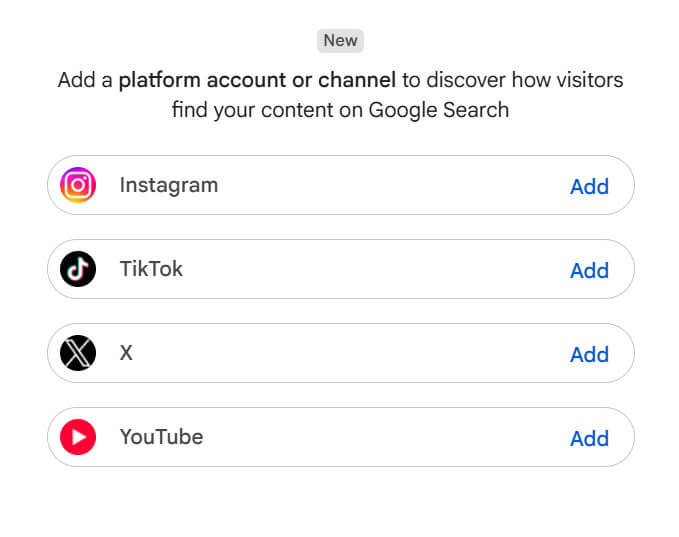
Google recently introduced Platform Properties, which allow you to add your Instagram, TikTok, X, or YouTube account as its own property within Google Search Console.
Once you’ve connected an account, you can start seeing how content from that platform is being discovered through Google. For example, if one of your Instagram Reels appears when someone searches for a topic you regularly talk about, Search Console can give you more information about that visibility.
And this is what makes the update particularly interesting to me.

We talk a lot about creating content across multiple platforms, but understanding how people actually discover that content hasn’t always been easy. Platform Properties give us another source of data to work with instead of simply guessing which topics might be gaining traction.
It also changes the way we can think about Google Search Console. Your GSC account doesn’t have to give you information about your website alone. You can now look at different parts of your online presence individually and get a better understanding of how Google is connecting people with the content you’re publishing.
For therapists and helping professionals who are already investing time into social media, that’s valuable. If you’re spending time creating educational Instagram posts or recording Reels, you now have another way to understand whether that content is being discovered beyond Instagram itself.
What Can You See When You Connect Instagram to GSC?
If you’ve used Google Search Console for your website before, some of these metrics will look pretty familiar.
You’ll be able to look at things like:
- Impressions: How often your Instagram content appeared across Google Search.
- Clicks: How often someone clicked your Instagram content from Google.
- Click-Through Rate (CTR): The percentage of impressions that resulted in a click.
- Average Position: The average position where your content appeared in search results.
- Search Queries: The actual searches people used when your content appeared.
- Individual Content: Which specific posts or Reels are receiving visibility and traffic from Google.
You can also dig deeper into your performance and look at trends over time.
For me, the search query data is one of the most interesting parts.
If you’re a therapist who regularly creates content about ADHD, anxiety, couples therapy, trauma, or another specialty, you can begin seeing the language people are using when they discover that social content through Google.
What does this look like in real life?
Let’s say you regularly use the phrase “emotional dysregulation” in your content, but Search Console shows that people are finding one of your posts after searching questions about feeling overwhelmed by small things or having trouble controlling their emotions. That gives you insight into the language your potential clients may actually be using.
And that information doesn’t have to stay inside Search Console. It can help influence what you talk about next.
You could use those searches to brainstorm another Reel, expand a social post into a blog, revisit an existing service page, or answer a related question you haven’t covered yet. Instead of treating your GSC data as something you check once a month, you can begin using it as part of your content-planning process.
No, This Isn’t the Same as Tracking Instagram Traffic to Your Website
This is one distinction that’s really important to understand.
Connecting your Instagram account to Google Search Console does not tell you how much website traffic is coming from Instagram.
Instead, it tells you how people are discovering your Instagram content through Google.
Think of the path like this:
Google Search → Your Instagram post or Reel
rather than:
Instagram → Your website
Those are two different types of traffic and require different data to understand.
Platform Properties also aren’t replacing your Instagram Insights. If you want to know how your post performed within Instagram itself, you’ll still want to look at Instagram’s analytics.
Google Search Console gives you another piece of the picture: how that same content is performing when someone encounters it through Google.
That’s an important distinction because the two sources of data answer completely different questions.
Instagram Insights might tell you whether people saved, shared, watched, or interacted with a post within the app. Search Console can help you understand whether that content is also being surfaced when someone turns to Google with a question.
Neither source of data tells the entire story on its own.
Looking at both can give you a broader understanding of how a piece of content is performing and where people are discovering it.
Why Should Therapists and Helping Professionals Care?
You might be thinking, “Okay, that’s cool…but what am I actually supposed to do with this information?”
This is where I think the update becomes useful.
Let’s say you’re a therapist who specializes in ADHD and you’ve been consistently creating Instagram content around executive functioning, emotional regulation, ADHD in women, and relationships.
You open Search Console and notice that one of your older Reels about emotional regulation is suddenly receiving more impressions from Google.
Don’t just look at the number and move on.
Ask why.
What searches are leading people to that Reel? Is there a specific question that keeps appearing? Is this a topic you already have a blog about? Could the Reel become a longer blog? Could you create a part two? Is there another question related to the topic that you haven’t answered yet?
You could also discover that content you didn’t expect to perform particularly well is gaining visibility.
Maybe a Reel you posted six months ago is suddenly appearing more frequently in Google Search. That doesn’t mean you need to recreate the exact same post, but it does give you a reason to revisit the topic and understand why it may be relevant again.
The opposite can be helpful, too. If you’re spending a lot of time creating content around a particular topic but aren’t seeing much search visibility from it, that information gives you another data point to consider. It doesn’t automatically mean the content is unsuccessful, especially because Search Console isn’t measuring its performance within Instagram, but it can help you ask better questions about your strategy.
Now your social media planning isn’t relying entirely on brainstorming what you think people might want to hear about.
You have another source of information showing you what people are actually finding.
And for therapists and helping professionals who already have limited time for marketing, that can make content planning much more intentional.
What This Update Means for SEO for Therapists and Social Media Marketing
One of the reasons I’m excited about this update is that it gives us another way to understand the relationship between SEO and social media marketing.
At Simplified SEO Consulting, we talk a lot about how these strategies don’t have to exist in completely separate spaces. SEO for therapists can help your practice become more visible when potential clients are actively searching for services, while social media marketing gives you another place to educate, connect, and reinforce the topics you want your practice to be known for.
Now, Google Search Console gives us another way to see where those strategies may overlap.
If your Instagram content is appearing in Google Search, you can begin looking at which topics are gaining visibility, what people are searching for, and which individual posts are being discovered. That information can then help guide your broader content strategy.
Maybe an Instagram Reel deserves to become a full SEO blog. Maybe a search query gives you an idea for your next social media post. Or maybe you’re seeing the same topic perform well across your website and Instagram, giving you a reason to continue building content around it.
This doesn’t mean every social media post needs to be created for Google, and it certainly doesn’t mean social media replaces a strong SEO strategy. Your website, service pages, blogs, local SEO, and technical foundation still matter.
Instead, think of this update as another opportunity to make more informed decisions about your visibility.
The more we understand about how people are finding and interacting with our content, the easier it becomes to create an SEO and social media marketing strategy that feels connected rather than scattered.

Ready to Build a More Connected Visibility Strategy?
You don’t need to be everywhere or create something new every day to build a strong online presence.
You need to understand where your audience is finding you, what they’re searching for, and how the different pieces of your marketing can support one another.
If you’re a therapist or helping professional looking for support with SEO, social media marketing, or a strategy that brings the two together, our team at Simplified SEO Consulting can help.
- Schedule a free SEO consultation with our team to talk through where your practice is now and where you’d like your visibility to go next.
- Learn additional tips or facts about SEO, AI optimization, local SEO, and more by exploring our blog posts and podcast.
- Whether you’re trying to improve your website’s search visibility, better understand your SEO data, or build greater recognition for your practice across platforms, we’ll help you determine what makes sense for your goals.
Other SEO Services to Support Your Online Growth
At Simplified SEO Consulting, we offer a variety of services to meet you exactly where you are. Want a one-on-one approach? We have that. Prefer to hand it off to the professionals? We have that too!
Our Done-for-You SEO Services are ideal for helping professionals who want to improve their Google rankings without having to learn SEO themselves. We take care of everything, from optimizing your website to crafting keyword-rich content, so you can focus on your clients.
Prefer a more self-paced approach? Our DIY SEO Courses are built specifically for therapists and wellness professionals. You’ll learn practical, proven strategies to optimize your website at your own pace, with support from instructors who speak your language.
Need help with behind-the-scenes improvements? Our Technical SEO Services address the foundational pieces that impact how search engines crawl and rank your site. Examples: site speed, mobile optimization, and metadata.
Our social media management package helps therapists maintain a consistent, professional presence across platforms while keeping messaging grounded, human, and supportive.
And if words aren’t your thing, we’ve got you covered. Our SEO Copywriting Services combine compelling, human-first language with keyword strategy to help you rank in Google and connect with your ideal clients.
About the Author
Olivia Ferguson is the social media manager at Simplified SEO Consulting and a search visibility specialist. She helps private practice owners and helping professionals grow their online presence with strategic, story-driven content. Olivia graduated with a social work degree from Central Michigan University. She combines her passion for mental health with a love for marketing that actually feels human.




Leave a Reply
Want to join the discussion?Feel free to contribute!